Scaling a tech startup means getting revenue to grow much faster than the organization behind it. In Latin America, where many ventures grow without outside capital, a good share of the mistakes that get in the way stem from decisions made out of necessity. Among the most frequent are accepting clients and requests that pull the company away from what makes it different, letting the founder keep handling everything, hiring what the cash allows rather than what the company needs, and growing slowly without a goal and a deadline that force change. How to correct them depends heavily on each organization, which is why it is a topic for the board.
Many tech startups in Latin America are born and grow without venture capital, funded by their founders’ savings and, above all, by what their first clients pay. When they also sell a product that embeds specialized knowledge of a niche (document management in a regulated industry or agribusiness traceability, to name a couple of examples), that knowledge protects them from being copied, but day-to-day reality forces the founder to make many decisions out of necessity, with this month’s cash as the main criterion.
Those decisions are usually right at the time, and in many cases they are what allows the company to survive. The problem shows up when the company wants to stop growing little by little and start scaling, that is, to get its revenue to rise much faster than its structure, and discovers that several of the things that brought it this far are the same ones now holding it back.
At Buho we have experience scaling technology companies specialized in knowledge niches and specific technologies, with clients in more than 70 countries across 6 continents, and today we work from the boardroom with companies going through that transition. The mistakes that follow are ordered by the moment they tend to appear in a founder’s life. They are not the only ones, and we approach them with empathy, because we know them up close.
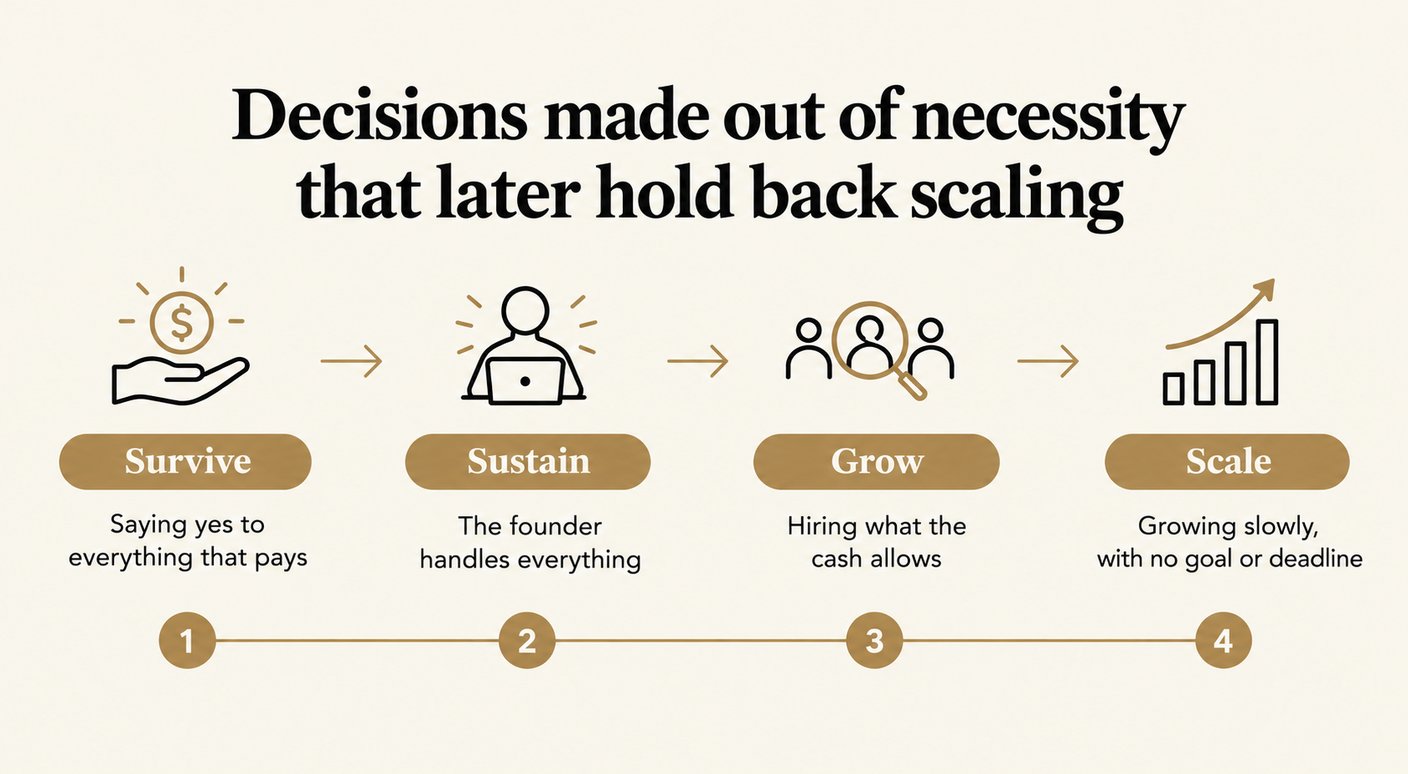
Chapter 1. Saying yes to everything that pays
In the early years, every new client is a small victory and often makes the difference between meeting payroll or not. In Latin America, a venture that is just starting out cannot afford to turn down a multinational client with a large budget, even if that project pulls it away from its focus. That client brings revenue and also a reference that opens doors, so accepting it is usually the right call. We discuss the challenges of that relationship in Selling to a Much Larger Client: A B2B Guide.
The harder case comes later, when the company already has an important, well-established client asking for a new feature. It is useful for that client and might eventually serve another one or two, but it will not be core to the product. Accepting it is perfectly valid if the company needs the money, and it often does. What matters is accepting it knowing what it costs. The hours the team spends on that feature are hours it does not spend building what would be useful to every client and what would allow the company to scale. Moreover, the feature does not end the day it ships, because it becomes part of a product that from then on is harder to maintain, explain, document, test and sell. Every new release has to keep supporting it, every sales demo has to work around it or justify it, and every new team member has to learn to live with it.
We saw this up close at a specialized software company on whose board we sit, where a major version of the product kept adding capabilities in pursuit of synergies and ended up more complex in every respect, to the point of slowing down the growth it was supposed to accelerate. Repeated over a few years, this mechanism turns a product company into a custom development shop, a risk we explore in Software Outsourcing in the AI Era: Beyond Price. The board’s job is to look at the accumulated effect rather than each request, with questions such as how many hours last year went to requests from a single client, or which parts of the product are used by only one or two clients.
Chapter 2. Letting the founder keep handling everything
Without the capital to hire senior people, the founder of a bootstrapped startup does everything. They sell, put together proposals, take part in implementations, deal with the angry client and define the product. In a specialized-knowledge company they are also usually the person who knows the niche best, the one who understands the industry’s regulation or the details of the process the software solves. During the early years that is an advantage, because no one conveys the value proposition better or spots sooner what the client needs.
The signs that this stage is over are quite concrete. The proposal for a large client waits a week because only the founder knows how to put it together, support for the most important client still lands on their phone on a Sunday night, and product decisions are put off until they are back from a trip. At that point the company can no longer grow faster than its founder’s calendar. We lived through this when scaling our own companies to dozens of countries, where there comes a time when the number of markets and time zones makes it impossible for a single person to be everywhere.
The transition tends to arrive, planned or not. Noam Wasserman, then a professor at Harvard Business School, analyzed 212 U.S. startups and found that by the time they were three years old, 50% of founders were no longer CEO (Wasserman, 2008). Planning for it is a board matter, and a delicate one, because the founder is usually also a shareholder and a member of that same board. It is best raised early, as a plan for the expert knowledge to move from the founder’s head into the product, the processes and other people, before a crisis forces it. We wrote about the attributes that distinguish a founder able to navigate that transition in How to Evaluate a Startup Founder: 7 Attributes.
Chapter 3. Hiring what the cash allows
When there is finally some room to hire, the temptation is to stretch it as far as possible. What a senior engineer costs can pay for two juniors, and a good regional sales manager’s salary can cover three inexperienced salespeople. On the spreadsheet it looks like the best possible deal, and for a company financed by its own cash it is a very understandable decision.
The cost shows up a few months later. Junior profiles need guidance, and that guidance almost always ends up coming from the founder, who is back at the center of everything. The company is bigger but not necessarily better. The Startup Genome Report Extra on Premature Scaling, prepared in 2011 with data from some 3,200 tech startups, found that the teams of startups that scaled prematurely were three times larger than those of consistent startups at the same stage (Marmer et al., 2011).
The alternative is to hire fewer and better people, pay well those who make the difference, and accept that one excellent person delivers more than several average ones. The best profiles prefer to be led rather than closely supervised, which frees the founder instead of loading them further and raises the bar for the rest of the team. The uncomfortable flip side is deciding what to do with those who do not want to come along, sometimes people who have been there from the start and prefer to guard their own turf, and here the board can help the decision be made with perspective and with less personal weight.
Chapter 4. Growing slowly, without a goal and a deadline that force change
Once the company stabilizes, the most common growth plan is also the most prudent one, which consists of growing 20% or 30% a year, reinvesting what is earned and opening a new market when cash allows. It is reasonable, and for a company without outside capital it is almost a reflex. The problem is that a goal like that can be reached by doing a bit more of the same, so it does not force anyone to rethink anything.
The deadline matters as much as the goal. If you give yourself a year to enter a new market, you will not make a single decision about it this afternoon, and probably not next week either, because there always seems to be time to analyze it a bit more. If the deadline is two months, on the other hand, you have no choice but to explore different, more direct paths. With a year ahead, entering Mexico gets planned with a market study, an exploratory trip and an industry trade show. With two months, the question becomes who already sells to the clients you want to reach and could add your product, or which of your current clients has a subsidiary there and could be the first one. A short deadline does not make you walk the same path faster; it forces you to find a different one, with fewer stages and without the tasks that were done more out of habit than necessity.
That speed refers to decisions and focus, and it is perfectly compatible with a lean company, without falling into the mistake described in the previous chapter. For a board, a useful question is what the company would do if it had to reach its goal in half the planned time. Sometimes the answer reveals which activities are unnecessary, and sometimes that the goal was poorly framed. Defining that goal and its deadline is probably the most important conversation a board that wants to scale can have, as we argue in Strategic Thinking for CEOs: A Practical Guide.
Chapter 5. Conclusions
The mistakes we have reviewed stem from decisions that, at the time, were reasonable or simply unavoidable for a startup funded by its own cash, and that become a brake when the company wants to scale. That is why they are worth reviewing without blame, with an eye to recognizing in time when a survival decision started turning into a limit.
How to correct them depends enormously on each organization, on its founders and what they want for the company, on the culture they built, on the market they compete in, on the technology, on how replicable the model is in other countries (a topic we cover in International Expansion: Localize the Business), on how easy it would be for a competitor to copy it and on how many competitors it faces, among many other variables. The same multinational client that is the chance to take off for one company can be, for another that looks almost identical from the outside, the start of a dispersion that takes years to recover from.
As a concrete recommendation, we suggest the board devote a full session, free from the month-end rush, to reviewing which of these mistakes are happening in the company today, which decisions made out of necessity should start to be unwound, and who is responsible for doing so.
Frequently asked questions
What is the difference between growing and scaling a startup?
A startup grows when it increases its sales by adding people and costs in roughly the same proportion. It scales when its revenue rises much faster than its structure, so it can serve many more clients without growing to the same extent. The difference depends above all on management decisions.
What are the most common mistakes when scaling a tech startup in Latin America?
In Latin American tech startups that grow without outside capital, the most common mistakes when scaling stem from decisions made out of necessity: accepting clients and requests that pull the company away from what makes it different, letting the founder keep handling everything, hiring junior profiles because that is what the cash allows, and growing slowly without a goal and a deadline that force change.
Should a startup build a custom feature requested by an important client?
Building a custom feature for an important client is valid if the startup needs that revenue. It should be done knowing that those hours are not spent building what serves every client, and that the feature makes the product harder to maintain, explain, document, test and sell. The board should look at the accumulated effect of those requests rather than each one separately.
When should a startup founder stop handling everything?
A startup founder should start delegating when the company can no longer grow faster than their calendar, for example when large proposals wait because only they know how to put them together. That transition is best planned at the board level, so that expert knowledge moves into the product, the processes and other people before a crisis forces it.
How does an advisor help when scaling a tech startup?
An advisor brings the experience of having scaled other companies and an outside view of decisions that are hard to see from within. Their value lies in understanding in depth the needs, capabilities and limitations of each organization, rather than applying standard recommendations, and in helping the founder and the board find the best way to scale that particular company.

Buho Advisors — Technology advisory for boards in Latin America.
Real experience. Strategic vision.
Further reading
Founders, teams and premature scaling
Is your startup growing or scaling?
We help founders and boards of specialized technology companies find their own way to scale, based on what each organization needs, can do and cannot do yet.
Start a conversation →